Profile Cards
Profile cards contain all the rules specific to all models represented by that card. You may also use the profile card to keep track of the wounds sustained by your model(s), Ki Tokens and game effects.
-
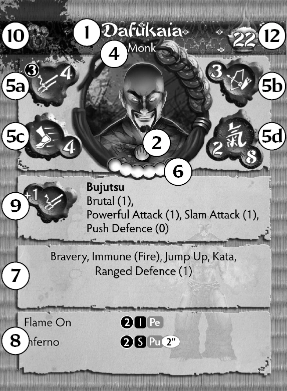
Name The name of the model(s). If this card represents a unique individual character rather than one or more generic profiles, this has a special border, and the Rice Cost is coloured Gold.
-
Elemental Icons Some models are aspected towards one or more of the six elements:
| Earth | Water | Fire | Metal | Air | Void |
|---|---|---|---|---|---|
 |  |  |  |  |  |
-
Base Size & Max Symbol If a profile has multiple base size symbols any of the available options are permitted.
Profile Cards without wound tracks have a MAX symbol on the back. Whenever a rule refers to the number of wound tracks use the MAX number instead. You can recruit up to this number of these models into a warband. -
Type The type indicates all the keywords that refer to the model. A model can have multiple types, these are separated by commas, and a model is always all of its types.
The Name and Types of models can often be referred to by other rules.
Traits often have a [Type] that singles out what models the trait affects. This [Type] can also be a model’s name.
Plural words are considered the same type as the same singular word for cards with multiple wound tracks. -
Statistics The number is the model’s base statistic value. Some effects modify a statistic, but it can never go above double its base value.
If a statistic is 0, it can be modified to a maximum of 1.
If a “-” icon represents a statistic, then it counts as 0 but cannot be modified by positive or negative modifiers.
Some models may have a Ki boost icon to the side of the Statistic value.
This is the Statistic’s Boost cost. This is the cost in Ki Tokens to increase the Statistic by 1.
Boosts remain only for the current Test or Movement. A player may increase a Statistic multiple times (to a maximum of double its base Statistic), as long as there are Ki Tokens available to do so.
Boosts are considered Ki Feats.
5a. Melee Pool Statistic This is the number of dice the model uses when resolving an Opposed Melee test.
5b. Ranged Pool Statistic This is the number of dice the model uses when resolving a Ranged Attack.
NOTE
Many models will have some Ranged pool statistic even if they do not have a ranged weapon. Perhaps they can be bought a ranged weapon or use the ability in some other way.
5c. Move Statistic The distance the model can move in inches when it makes a movement that specifies this distance. Also, the number of dice rolled for a Move Test.
5d. Ki Statistic/Maximum Ki Limit
The Ki statistic is actually 2 statistics represented by 2 numbers written X/Y.
The X number is the model’s Ki statistic. This tells you the amount of Ki Tokens each model represented by this card generates during the Starting Phase and the number of dice it uses for Opposed and Challenge Ki tests.
The second Y number is the model’s Ki Limit, the maximum number of Ki Tokens each model represented by this card can have at any one time. If it would gain more than this, any excess is discarded.
- Wounds Track
The number of wounds a model can suffer. When a model suffers wounds an equal amount are marked from its Wound Track.
When a model is reduced to 0 wounds remaining on its Wound Track it is Killed; remove the model from the table.
When a model Heals wounds, it recovers marked wounds from its Wound Track.
A model cannot Heal more than it has marked wounds.
Some cards have multiple Wound Tracks to use for multiple identical models. The number of Wound Tracks is the limit to how many of these models you may recruit or Summon into a Warband, either at Warband Creation or during the game.
Some Profile Cards, such as Kami models, have a Max symbol on the back next to their Size. These Profile cards are usually ones that have no wound tracks.
Whenever a rule refers to the number of Wound Tracks use the Max number instead if the card has one. You can recruit up to this number of these models into a Warband.
- Traits
Each model may have several traits that describe how it behaves in the game. This makes those traits easier to find when you need them.
Some Traits are Weapon Traits; these are listed on the model’s weapon grid and are only in effect when using that weapon.
Traits Reminder Text
Starter set cards have reminder text for all their traits. Remember this is just a reminder of the rule; the full version is in this rulebook, always look up the complete rules text if there is an issue mid game for clarification.
-
Ki Feats Ki Feats available to the model(s).
-
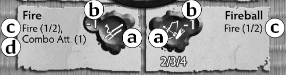
Melee and Ranged Weapon Grids All models in Bushido have a melee weapon, though for any they are fists and feet or claws and teeth. Some also have a ranged weapon.
The weapon grid also lists any weapon traits that are in effect when using that weapon, as well as any special attacks and defences that are available when using that weapon: a. Designates the weapon as either a Melee or Ranged Attack weapon. Ranged Weapons have Range Bands.- Short Range (first value): Ranged Attacks against Targets up to and including this distance are at Short Range.
- Medium Range (second value): Ranged Attacks against Targets beyond Short Range and up to and including this distance are at Medium Range.
- Long Range (third value): Ranged Attacks against Targets beyond Medium Range and up to and including this distance are at Long Range.
- Ranged Attacks against Targets at distances exceeding the weapon’s Long Range automatically fail. b. A weapon’s Strength modifier to any Damage Rolls made by this weapon. Sp Indicates a special effect instead of a standard damage roll The attack does no damage, some of these weapons have properties detailed in the Unique Effects section of the model’s profile card. c. Any Traits associated with the weapon. d. Any Special Abilities available when using that weapon.
-
Faction Symbol Which Faction the model belongs to. Some models are from the Ronin pseudo-Faction.
Your Warband can only recruit models that belong to your chosen Faction, or Ronin models recruitable by your chosen faction as indicated on the Ronin model’s card. -
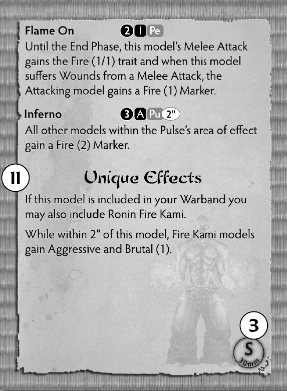
Unique Effects Any additional rules that are not Traits or Ki Feats.
-
Rice Cost The cost to recruit this model into your Warband.
Models with Su are Summoned models that enter play during the game through a Ki Feat or Unique Effect and cannot be recruited when creating your Warband.
Models with Sp are models with a special rule which will be explained on its profile card and cannot be recruited when creating your Warband.
If a card’s Rice Cost is followed with ea, then more than one model represented by that card may be recruited into your Warband. Each model recruited pays the cost specified.
If a model’s Rice Cost is increased or decreased by a Theme list or other rule, the original printed Rice Cost is still used for all game effects relying on the Model’s Rice Cost.
Special Cards
Faction decks include special cards specific to each faction, with a Ronin set of special cards available to all.
Each card can be recruited X times per Warband based on its Max (X) trait.
If a card has no printed Max (X) trait, it is assumed to be Max (1).
There are three types of Special cards that players can recruit when creating their Warband - Enhancements, Events, and Terrain. Each type acts differently in how and what they affect during the game. These are explained in detail below, but all special cards are comprised of the following features:
- Name: The card’s name.
- Faction: Special cards may only be purchased if they have the same Faction symbol as the Warband, or the Ronin Faction symbol.
- Type: This specifies if it is an Event, Enhancement or Terrain card.
- Description: Describes the card’s effects.
- Traits: Traits that apply to that card.
- Rice Cost: The cost to recruit the card for the Warband. If the cost is variable its X value is chosen and locked at Warband Creation. Costs cannot be modified below 1 Rice.
Some cards say to Discard the card after a specific trigger happens. A Discarded Special card has no effect on the game from that point onward.
Enhancement Cards
The player must decide which profile card an Enhancement card is Attached to during the creation of their Warband. During play, place an Attached Enhancement card under the chosen profile card. The model(s) will benefit from the effects detailed on the card for as long as it is Attached to the model(s)’ profile card.
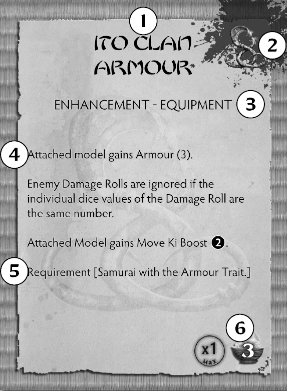
Models with the Insignificant trait cannot have Enhancement cards Attached to their profile cards during Warband creation. Animal, Construct, Kami and Swarm models may only have Enhancement cards that specifically name them as Required.
Some models have multiple profile cards. If a card says X and Y are considered the same model when creating a Warband, then any Enhancement cards bought for either card are moved to the one starting in play before the game.
Some cards represent multiple models and have multiple wound tracks. Enhancement cards will specify if they can be bought for such models multiple times or can only be bought for a single model on the card. In the case of enhancements applied to a single model on a card representing multiple models, the enhanced model must be distinguishable from otherwise identical models without the enhancement.
Enhancement Card Traits:
- Equipment: This represents a physical item. A model may have only one Equipment card attached to it.
- Max (X): This card can be purchased for a Warband up to X times.
- Requirement [Type]: This card can only be Attached to this type of model.
- Exclusion [Type]: This card cannot be Attached to this type of model.
Event Cards
Event cards are played once, at a time detailed on the card. Once the card is resolved, then it is discarded and removed from the game.
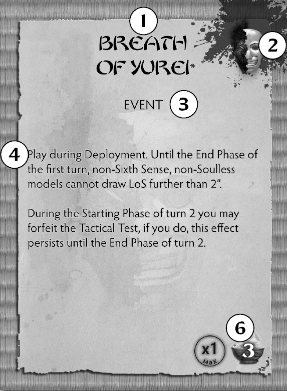
Unless stated otherwise Event Cards are used in the same way as Instant Ki Feats. They are not, however, considered to be Ki Feats.
Some event cards may result in another special card being put into play, often as a result of some action on the table. In these cases, the other special card will be printed on the reverse side of the Event card and can only be recruited in this way.
Event Card Traits:
- Max (X): This card can be purchased for a Warband up to X times.
- Requirement [Type]: This card is restricted in how it can be played or recruited and requires a [Type] of model or specifies another restriction.
A Warband recruiting an Event – Curse card must play the Event as directed on the card. You may not choose to keep it unplayed. To Recruit a Curse Card that affects models, you must have at least one model in your Warband that is affected by the Event - Curse card.
NOTE
Only Event – Curse cards are affected by this, not ordinary Event cards, even if they have the word Curse in the name.
Terrain Cards
Terrain cards allow a player to deploy a specified Terrain element on the table during the player’s normal Deployment of their Warband.
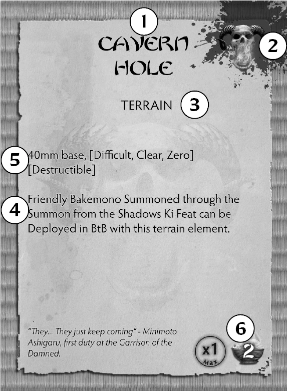
Terrain elements deployed due to Terrain cards must follow standard rules for Terrain element deployment unless stated on the card.
If restrictions mean that the terrain cannot be deployed, the opposing player must make as small an alteration as possible to allow the bought terrain to be placed.
Terrain Card Traits:
Destructible
A model in BtB with this terrain and not in an Enemy model’s ZoC can declare a Wait Action to remove it from the Battlefield.
Link to original
Models that are Aloof, Animal, Insignificant or have a Max Ki Limit of 0 cannot perform this effect. This will not trigger effects listed on Friendly terrain.
Requirement [Type]: This card is restricted in how it can be played or recruited and requires a [Type] model.
For Passage, Visibility and Size traits see Terrain.
Communal Cards
Some factions have access to a Communal Card. These cost no Rice and can always be recruited. You may only recruit one Communal Card with the same name.
Example
A warband has recruited Bakemono Horde “Out of the Underworld” so it may not recruit the Bakemono Horde “The Shadow Council” communal card.
Some Communal Cards are used to pool together all the Ki generated by their community profiles. If this is the case, all community profiles will have a maximum Ki listed as *.
Such models never have Ki, effects that would gain them Ki, including Channel, Leech, Ki Generation, the Focus Action or any Ki Feats or other effects instead add Ki to the communal card.
Communal Profiles with a * for maximum Ki are not subject to abilities that remove Ki from them. For example, they cannot be Leeched from and the Psychic Drain Ki Feat has no effect.
Some Communal Cards may grant other abilities, similar to Unique Effects on a profile card. Some Communal Cards add new feats to the community profiles. Always read these as if they were printed on the profile card.
Theme List Cards
A player can only use one Theme per Warband. Themed lists allow you to trade restrictions in Warband composition for other bonuses during gameplay. Unless otherwise stated, Theme benefits only affect Friendly models.
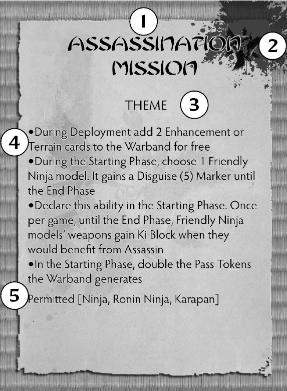
Example
Aiko is recruited into the Righteous Warriors Theme. Silverback can now be recruited even though animals, gorillas and Silverback are not listed in the Permitted models.
Theme Card Traits:
- Permitted (Type): Only models with a matching type can be recruited into this Warband, Ronin models of the type may only be included if the theme states Ronin of that type are permitted.
If a Theme list card does not have this trait, all models from the chosen Faction are available to recruit into the theme.
If a Ronin Theme list card does not have this trait, all models from the chosen Faction and all Ronin available to that Faction are available to recruit into the theme. - Exclusion (Type): Models with a matching type cannot be recruited into this Warband.
If a profile qualifies for both the Permitted and Exclusion of a theme, the Exclusion takes priority, and the model may not be recruited.
Some models or special cards, when recruited into a Warband, permit other models to be recruited.
Other models may require a specific model to be recruited into the Warband before they can be included.
If a model is permitted in a Theme then any model it allows to be recruited is also allowed in the theme regardless of any Exclusion.
If a model or special card is permitted in a theme list, any model summoned by that model is also allowed to be summoned.
Theme Benefits: Unless otherwise stated, Theme benefits only affect Friendly models.